
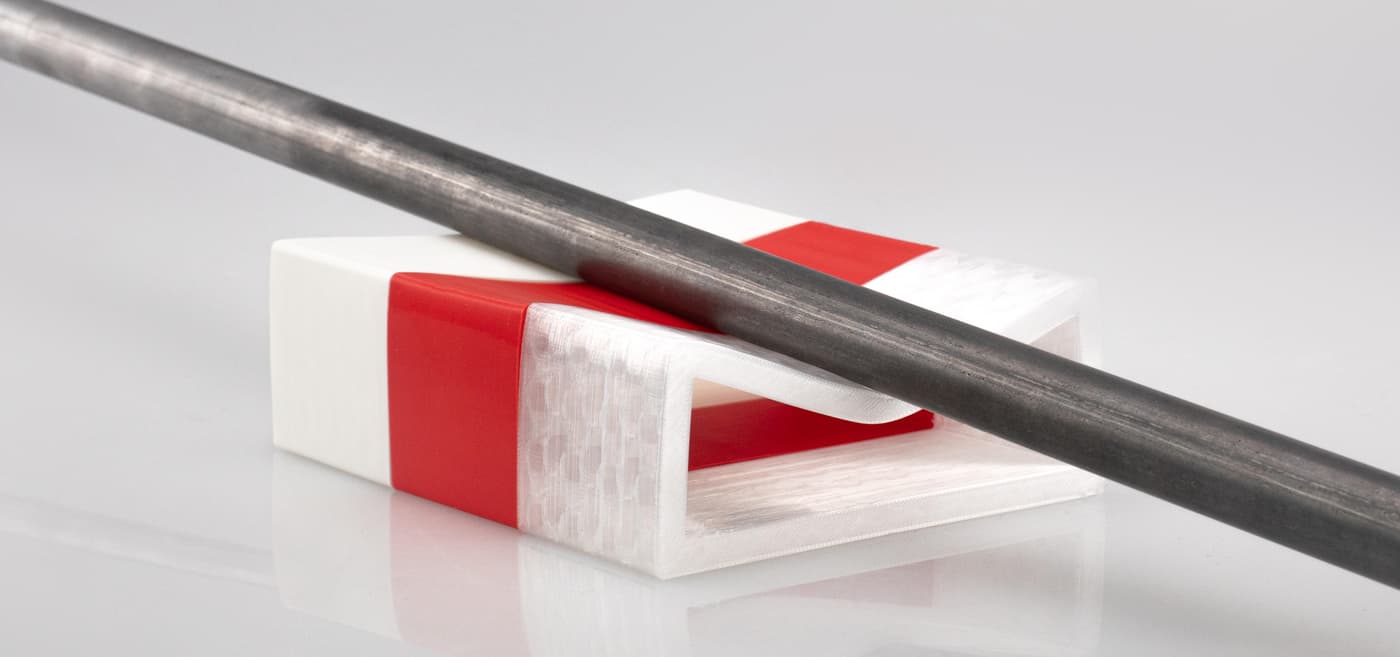
Flexible 3D printing filaments are essential in modern product development.
From soft-touch consumer products to industrial components that need to absorb impact, more and more applications require materials that don’t just resist force, but adapt to it.
This is where TPU-based filaments come in.
They combine flexibility, durability, and long-term performance, making them ideal for parts that need to bend, compress, or withstand repeated stress without breaking.
But not all flexible filaments behave the same.
Choosing the right level of flexibility is key. Too soft, and your part won’t hold its shape. Too rigid, and it won’t perform as intended.
In this guide, we’ll explain how flexible 3D printing filaments work, what Shore hardness means, and how to choose the right TPU FLEX filament for your next application.
What Are Flexible 3D Printing Filaments?
Flexible filaments, typically based on TPU (thermoplastic polyurethane), are designed for parts that need elasticity, impact resistance, and long-term durability.
They are widely used in:
- Industrial applications (seals, dampers, connectors)
- Product design (wearables, soft-touch surfaces)
- Mechanical components exposed to repeated stress
Understanding Shore Hardness in TPU Filaments
Shore hardness describes how soft or rigid a flexible filament feels, but it's more than just a single scale.
Flexible materials are typically measured using two different Shore scales:
- Shore A → used for softer, more elastic materials
- Shore D → used for harder, more structural materials
In general:
- Lower Shore A values (e.g. A85) → softer, more elastic, higher grip and damping
- Higher Shore A values (e.g. A98) → firmer, more controlled flexibility
- Shore D values (e.g. D58) → significantly more rigid, with structural stability
However, Shore hardness alone doesn't fully define performance. The actual behavior of a printed part also depends on:
- Part geometry (thin walls vs solid parts)
- Infill and wall thickness
- Print orientation and layer adhesion
A softer material can feel rigid in thick sections, while a harder material can still flex in thin geometries.
In practice: Shore hardness is a guideline for material selection, but the final part behavior is always a combination of material and design.
Introducing FLEX Semisoft: Maximum Flexibility and Softness
Key properties:
- Shore A85
- Elongation up to 550%
- Heat resistance ~98°C
FLEX Semisoft is built for applications where softness and stretch are required.
It can bend and compress repeatedly without tearing, making it ideal for:
- Wearables
- Grips and ergonomic components
- Protective pads
- Damping elements
👉 Best for: soft-touch, user-facing, and cushioning applications
Introducing FLEX Medium: Balanced Flexibility and Control
Key properties:
- Shore A98
- Elongation up to 470%
- Heat resistance ~115°C
FLEX Medium offers a balance between flexibility and structural integrity.
It maintains shape under load while still allowing movement.
Typical use cases:
- Seals and gaskets
- Connectors
- Soft-mechanical parts
- Components with repeated flex cycles
👉 Best for: functional parts that require both movement and stability
Introducing FLEX Hard: Structural Strength with Controlled Flex
Key properties:
- Shore D58
- Elongation up to 480%
- Heat resistance ~140°C
FLEX Hard combines flexibility with mechanical strength and dimensional stability.
It is suitable for:
- Industrial housings
- Mounts and brackets
- Jigs and fixtures
- High-load applications
👉 Best for: semi-rigid, load-bearing and impact-resistant parts
| Property | FLEX Semisoft | FLEX Medium | FLEX Hard |
| Shore Hardness | A85 | A98 | D58 |
| Flexibility | Very high | Medium | Low |
| Shape Stability | Low | Medium | High |
| Heat Resistance | up to 98°C | up to 115°C | up to 140°C |
| Typical Use | Wearables | Seals | Mechanical parts |
Why Flexible Filaments Are Needed in Engineering and Design
Flexible materials are increasingly used across industries:
- Automotive: vibration damping, clips, protective parts
- Consumer products: ergonomic and soft-touch design
- Industrial tooling: seals, flexible connectors
- Robotics & prototyping: movement-driven components
Rigid materials resist force. Flexible materials absorb and distribute it.
That difference is critical in functional use cases.
How to Choose the Right Flexible Filament
Ask yourself:
1. How much flexibility do you need?
- High → Semisoft
- Medium → Medium
- Low → Hard
2. Does the part need to hold its shape?
- Yes → Medium or Hard
3. Will it face mechanical stress or heat?
- Yes → Hard
4. Is it user-facing?
- Yes → Semisoft
Printing Tips for TPU and Flexible Filaments
To achieve consistent results:
- Store the filament in a dry place and dry it before use
- Use slower print speeds
- Ensure proper filament guidance
- Optimize retraction settings
For best results, use our custom made Extrudr Material Profiles, which provide pre-tested settings for reliable printing .
Conclusion: Flexibility as a Functional Advantage
Flexible filaments are not just a niche material.
They enable new product designs, improve durability, and expand functional possibilities in 3D printing.
With the right TPU filament, you can design parts that don’t just withstand stress, but perform under it.
Learn more about our FLEX range 3D printing filaments and choose the right one for your next print project.