

The Aerospace Team Graz (ASTG) is an interdisciplinary student association that develops rockets for international competitions. By winning the overall victory at the EuRoC 2023 (European Rocketry Challenge) and other prizes in previous years, the team has established itself as one of the best university groups in Europe.
Precise component assembly with filament
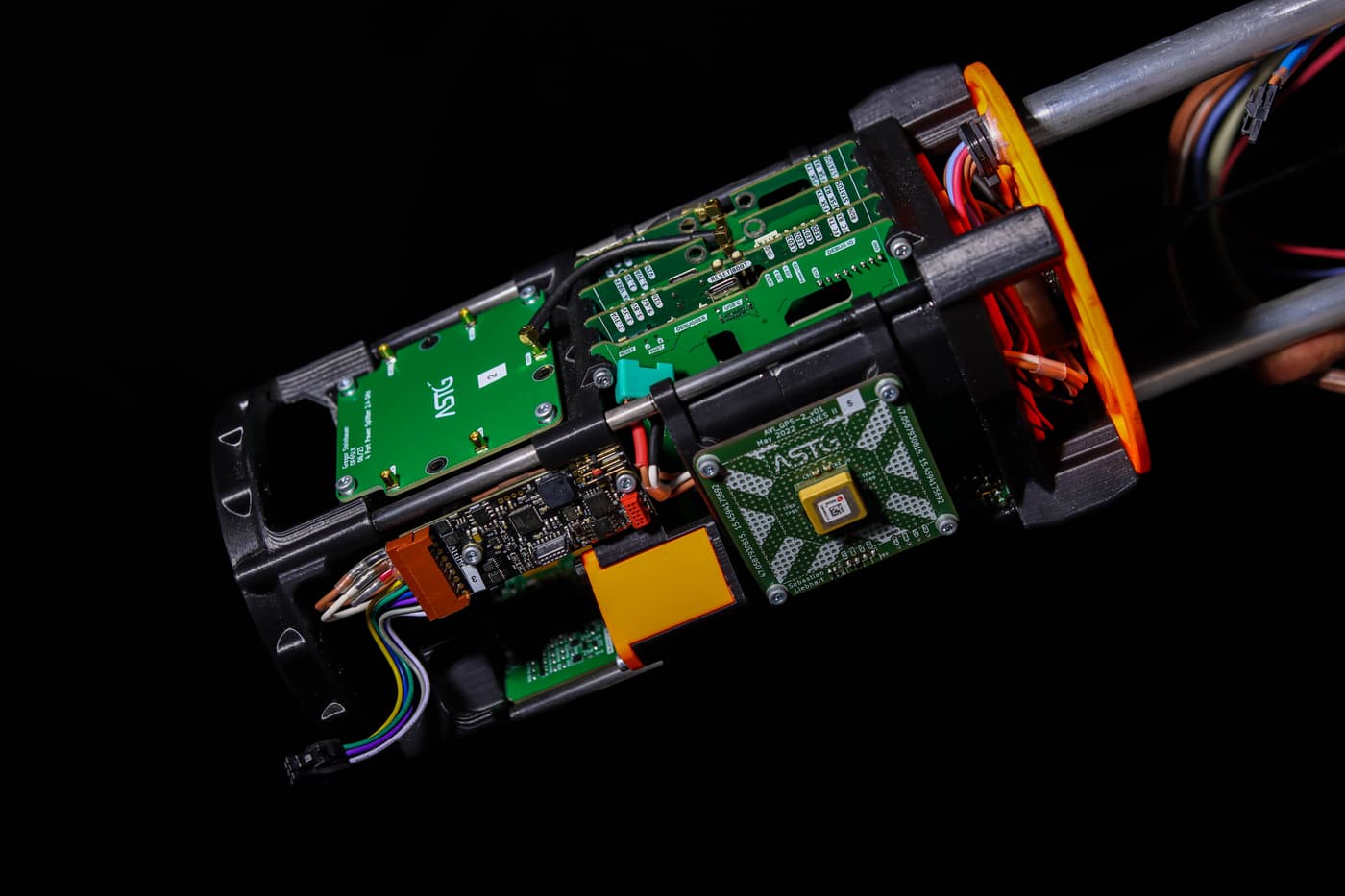
Filament is a versatile material for the production of component holders in the rocket. These brackets carry components such as circuit boards, flight computers and onboard cameras, which are essential for the control and data acquisition of the rocket.
Prototype development for complex assemblies
Before expensive metal components are manufactured for the rocket, the Aerospace Team Graz creates prototypes from Extrudr PLA NX2. This approach makes it possible to test and optimize the functionality and resilience of the components in advance. This enables the team to identify design errors at an early stage and avoid costly production errors.
Airbreak model
Second deployment cover: protection through innovative choice of material
A particularly innovative application of filament is the second deployment cover. This component plays a crucial role in the safe opening of the rocket's main parachute. The parachute is initially prevented from opening by a deceleration chute and a line. As soon as the rocket has reached the desired height, an explosive charge is detonated, which destroys the bolt on the line and releases the main parachute.
To withstand the high forces generated when the bolt is fired, a material with special properties was required. After extensive testing, FLEX Medium proved to be the best choice. Unlike materials such as Kevlar or carbon fiber, which could be punctured by the bolt, FLEX Medium absorbs the energy and prevents damage to the second deployment cover.
Second deployment test