
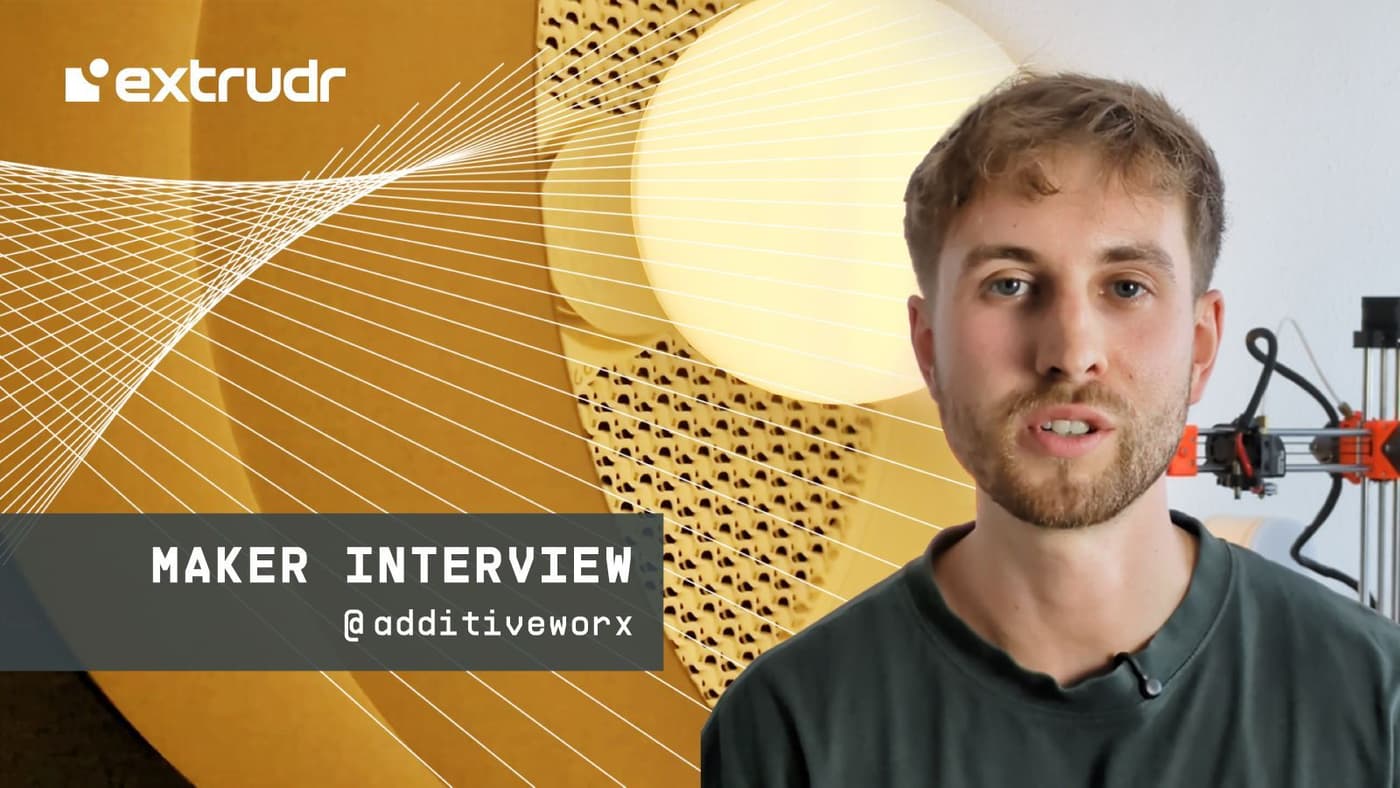
Meet 3D Maker Sebastian of Additiveworks
He studied mechanical engineering, spent years as an industrial engineer, and now spends every day designing lamps, coffee accessories and everyday fixes that anyone can download and print at home. In the first installment of our Introducing 3D Maker series, Sebastian of Additiveworks talks us through his workflow, his material choices and what keeps him printing.
From the factory floor to full- time design
Tell us a bit about yourself.
I'm Sebastian, 29, from Germany. I studied mechanical engineering and worked for several years as an engineer in industry. These days I spend my time designing 3D printed products under my own brand, Additiveworks. I design models that people can download and print themselves at home, things like lamps, coffee accessories, pen holders, all sorts really.
How did you first get into 3D printing?
My first real contact with 3D printers was during my studies. I bought my first one in 2019, and back then I still had to assemble it completely myself. What fascinated me was the idea that you could quickly and affordably create or print anything you'd modeled, without needing a milling machine or a lathe at home, and without having to spend a fortune.
What was your earliest project?
A coffee dosing funnel for portafilter machines. I'd seen one at a café, used by a barista, and needed something similar for my own machine at home. So I modeled it myself and printed it.
From sketch to finished piece
What does your typical workflow look like?
It usually starts with brainstorming, followed by a hand sketch. Then I model it directly in 3D, run test prints, and adjust the settings if needed. After that comes the final print, and once that's done, it's ready for product photos and everything else.
Which materials do you rely on most?
Mainly PLA, because it's excellent for aesthetic parts. It has a beautiful surface, often with a matte finish, and enough translucency for lamp designs. PETG matters to me too, for products that need to be heat resistant or more weatherproof. From Extrudr, I mainly use two things: PLA NX2 in matte, because the surface quality is fantastic and I like the colors, and XPETG in matte, which so far is the only PETG I've found that combines really good surface quality with the temperature resistance functional parts need.
What about tools beyond the printer itself?
The slicer is the most important thing, since it lets you adjust so much and print in a way that stays reproducible and repeatable. I also use a filament dryer, because filament can end up wet or damp, which leads to poor surfaces or print errors. A dryer prevents that.
Note: For the best print result with Extrudr filament, download our material profiles on extrudr.com.
Why printing beats the alternatives
Why choose 3D printing over something like injection molding?
Speed and affordable prototyping, that's really what's great about 3D printing. There's much less cost pressure too. If you make a mold for injection molding, that can easily cost one thousand or ten thousand euros, and everything has to be right by the end. With 3D printing, you can just print quickly, even if the part isn't perfectly designed yet, and you don't lose much if it doesn't work.
What draws you to infill and support structures as a design tool?
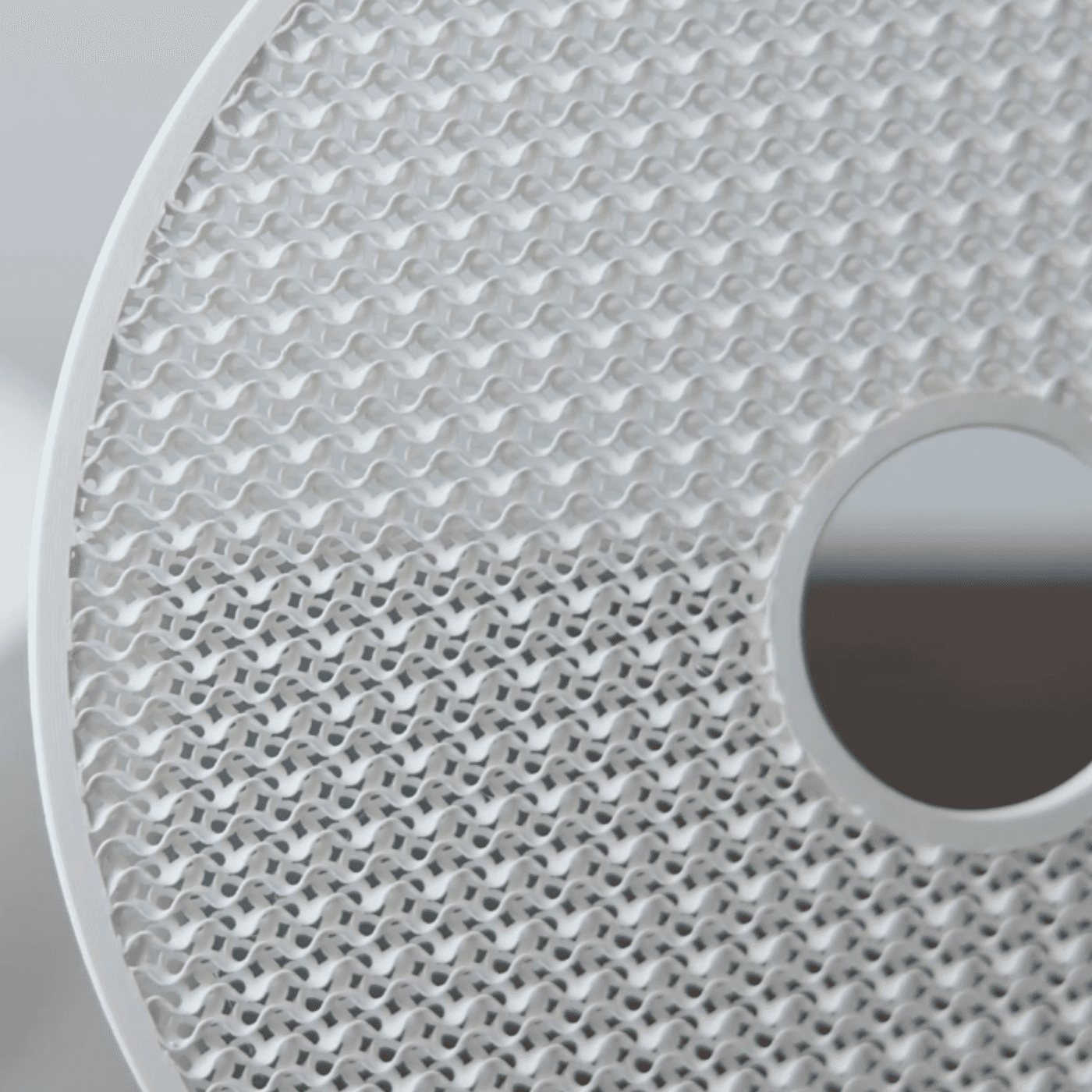
These grid structures are fantastic, because they let you generate beautiful patterns automatically. You can create undercuts or organic shapes that other manufacturing methods simply couldn't produce, or that would be far too expensive to make any other way. One example is a birdfeeder I designed, where you can see a gyroid structure on the outside. That kind of structure is very difficult, if not impossible, to produce with traditional manufacturing.
Choosing the right material
How do you decide which material to use for a new project?
It depends mainly on the intended use. Is it meant to be an aesthetic product, a decorative object, or more of a functional part that needs to hold up to heat or weather? Where possible, I personally like to use recycled material or biodegradable filament made from renewable resources. That's often not possible, though, because the material properties aren't always as good as what's needed. Availability is also a factor, since it can sometimes be tricky and you have to fall back on other options. And of course, quality and price are decisive factors if you actually want to sell what you make.
What is important to you in terms of color and finish?
I use a lot of pastel colors personally, so it's important to me that the colors I like are available. A matte surface is a real criterion for me too, since I enjoy designing in that style and I like giving my products that look. Translucency is also important, especially for lamps, so the filament breaks the light nicely and distributes it evenly.
Working with Extrudr filaments
How has your experience been ordering from Extrudr?
Consistently positive, which is why I mainly order from them. Very good printability, a beautiful surface, and those matte structures I like so much. I've rarely had a misprint, the filament is always dry straight from the factory, and it has really high strength, even the PLA. It's always a stable material.
What makes the matte filaments stand out for your work?
They're genuinely aesthetic and look great. Some designs only really become what they're meant to be because of that matte finish, a glossy PLA just wouldn't work for them. It's noticeably good. PLA NX2 MATT in particular has pleasantly surprised me, since it has higher strength than other PLAs I've used, some of which turned out to be unusable by comparison.
Craft, problems and finishing touches
How do you balance stability with aesthetics?
Mainly through the design itself. If something isn't stable enough, you need to make it thicker or design it differently. In the end, the right material and the right print settings are what really determine both the look and the robustness of a piece.
How do you handle support structures and finishing?
I try to avoid support structures whenever I can, because they never give you a great surface finish. You can always tell where a support was attached or broken away. Mostly I use heat, a heat gun or something similar, to remove stray strings, especially on PLA, or a knife to clean up finer details or cut away anything unsightly. I try to send back any failed prints or prototypes I can't use so they get recycled and I get new filament in return, or I sell them cheaper or give them to friends. Ideally nothing goes in the bin, though sometimes that's not possible.
What's been your most challenging project so far?
Probably the gyroid lamp. It's made of several parts with threads, all assembled without any support structure, and it uses a gyroid infill pattern with translucency built in so the light gets refracted the way I wanted for the lamp. That was definitely a challenge.
What do you do when a design doesn't work as planned?
Any design where that open structure is visible is genuinely difficult, or impossible, to produce with other manufacturing methods. There are also filaments my designs simply wouldn't have looked as good with, or wouldn't have worked with at all. So I always analyze the cause: was it the print settings, the slicer settings, or the design itself? I try to adjust things until it works. If it still doesn't work even with different settings, then I have to redesign or remodel it.
What's next for Sebastian
What's the biggest appeal of 3D printing for you?
The limitless possibilities for design. I might think of a design today, and tomorrow I can already have it modeled, and even printed. That speed, being able to create fast, affordable prototypes, is what makes printing so special.
Any materials you're planning to explore next?
I'll probably look into flexible materials, maybe combined with rigid ones. TPUs in different hardnesses, or something along those lines, that would definitely be interesting going forward.
What are people printing most right now?
Lamps are a big theme at the moment, of course. Then organizers, storage solutions, pen holders, and things that fix small everyday annoyances, like cables that keep falling down. I've made cable holders for that, and other things that just need a fixed place at home. You can quickly model and create designs like that yourself.
Where do you see 3D printing heading?
I think it will keep becoming more accessible and more capable. At some point I imagine almost every household will have a 3D printer at home. It'll also become less important for things to be traded and shipped online, because people might just print products themselves at home. You'd only need to download the file rather than buy the finished product. Material variety will grow too, and materials will get better, more diverse, more stable. My hope is that things can be produced locally at home, which would help the environment by reducing shipping, and that the recycling loop becomes more efficient, maybe even recycling at home, or at least sending everything to where it's genuinely recycled. We'll see what the coming years bring.
Watch the exclusive interview below.