

ECO-FRIENDLY 3D PRINTING MATERIALS: WHAT TO LOOK FOR
Bio-based filaments? Sounds promising, but how exactly does that work?
As 3D printing becomes more accessible, more people are asking a simple but important question: Can it also be sustainable? With so many filament options out there, it’s not always clear which materials are genuinely eco-friendly – or what that even means.
Is it about being bio-based, biodegradable, or both?
The reality is, these terms are often used interchangeably, but they refer to very different things. Understanding the difference is key if you want to make better, more informed choices – especially when you care about performance too.
At Extrudr, we’ve been working with bio-based materials from the beginning. While standard materials like PLA already use renewable resources, we’ve expanded our range of bio-based filaments to also include high-performance alternatives that are made to handle everything from hobby prints to industrial parts.
Let’s break down what makes a filament sustainable, how to spot the difference between bio-based and biodegradable materials, and how you can choose the right one for your next project.
WHAT MAKES A FILAMENT BIO-BASED?
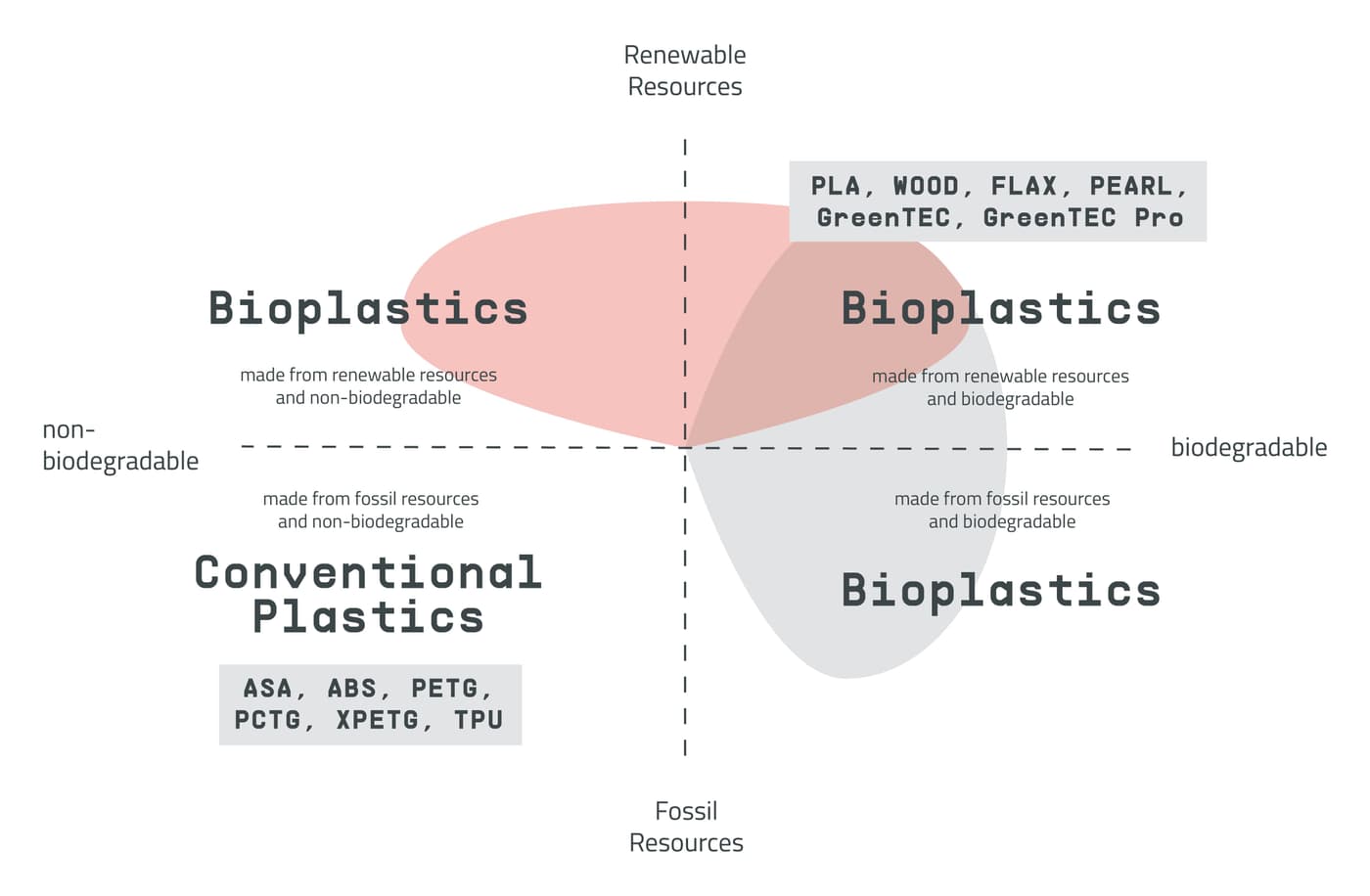
A bio-based filament is made from renewable raw materials like corn starch, sugarcane, or wood fibers, instead of fossil fuels. This reduces reliance on petroleum-based plastics and helps lower the overall carbon footprint of the product. But just because something is made from renewable sources, does not mean that it is biodegradable. Generally, bioplastics fall into three categories:
1. Made from renewable raw materials and biodegradable
2. Made from renewable raw materials and non-biodegradable
3. Made from fossil raw materials and biodegradable
At Extrudr, we focus on the first two categories, offering filaments that are bio-based and, in some cases, also biodegradable. Each type serves a different purpose. Let’s look at some examples.
MEET OUR BIO-BASED FILAMENTS
PLA Basic
What it’s made from: A bio-based
material made from fermented corn starch.
Why it’s great: Lightweight, strong, and easy to print. This filament
offers great results with minimal setup.
Best for: Prototypes, educational kits, and everyday prints
where reliability and simplicity matter.
PLA NX2 MATT
What it’s made from: A
next-generation PLA formulation derived from renewable sources, refined for
improved print quality.
Why it’s great: It delivers excellent dimensional accuracy and a
soft, matte finish straight off the print bed. Very forgiving, even on
lower-end machines.
Best for: Design-focused projects, presentation models, and
creative prints that need a premium look.
GreenTEC / GreenTEC Pro
What it’s made from: A bio-based
material made from fermented corn starch.
Why it’s great: Offers outstanding strength, heat resistance (up to
115°C), and a low-warp profile while remaining easy to print. Pro version meets
higher technical requirements.
Best for: Functional parts, jigs, and end-use components in
automotive, electronics, tooling, and other demanding sectors.
FLAX & WOOD
What it’s made from: Composites of
PLA blended with natural fibers like flax or wood.
Why it’s great: Prints with a warm, organic texture and natural
surface finish. Slightly porous appearance adds character and tactility.
Best for: Architectural models, product mockups, and creative
works where aesthetic and material storytelling are important.
PEARL
What it’s made from: A bio-based
PLA blend enriched with mica-like particles for a shimmering effect.
Why it’s great: Prints with a luxurious, iridescent sheen that changes
with lighting and angle – without compromising printability.
Best for: Premium product prototypes, artistic objects,
packaging concepts, and anything where visual impact is a priority.
These materials give you a range of options depending on your project.
BIODEGRADABILITY: WHEN DO FILAMENTS BREAK DOWN?
Now that we’ve looked at some of our core bio-based materials, there’s another term that often comes up in the same conversation: biodegradable.
It sounds like the natural next step. If a material is made from plants, shouldn’t it just break down on its own? Not necessarily. While some of our filaments are biodegradable, not all bio-based materials behave the same way at the end of their life cycle.
The key difference is:
- Bio-based refers to the origin of the raw material – usually renewable resources like corn, sugarcane, or wood.
- Biodegradable refers to the end-of-life behavior – whether the material can be broken down by natural processes into water, CO2, and biomass.
These two properties are not automatically linked. A filament can be fully bio-based and yet not biodegradable at all, depending on how it’s engineered.
One of the best-known examples for a bio-based and biodegradable filament is PLA. It’s made entirely from corn starch, making it 100% bio-based. But PLA only biodegrades under specific industrial composting conditions. For it to fully break down, it needs:
- Temperatures around 58°C
- High humidity
- Adequate oxygen levels
- The presence of microorganisms that can digest the polymer chains
According to the DIN EN 13432 standard, for a plastic to be labeled compostable, it must break down by at least 90% within 90 days in such an environment. In a certified composting facility, PLA can decompose within a few months. But in a regular home compost – or worse, in landfill – it behaves much like traditional plastic, taking years or even decades to degrade.
CONVENTIONAL PLASTICS AND THE NEED FOR RECYCLING
Not every project calls for bio-based materials. In many cases, conventional plastics like PETG remain a reliable and widely used choice thanks to their durability and versatility. At the same time, PETG, for instance, is one of the more recyclable options among fossil-based filaments, and there’s increasing interest across the industry for closed-loop recycling systems where materials can be recovered, reused, and reprocessed.
That’s why it’s more practical to think in terms of purpose, rather than thinking in absolutes like bio-based versus conventional materials. Ask yourself: What does your part need to do? How long should it last? And how can you minimize its environmental impact – whether through recycling, reduced waste, or regional production?
At Extrudr, we support this mindset by offering a carefully developed range of bio-based and recyclable materials, all produced in Lustenau, Austria, using clean energy and responsibly sourced raw materials. Our goal isn’t to limit your options – it’s to help you make more informed ones, so you can work efficiently while contributing to a more sustainable way of making.
CHOOSING SUSTAINABLE FILAMENT: WHAT TO LOOK FOR
So, what should you actually consider when choosing a more sustainable filament?
Start by checking if the material is bio-based, meaning it’s made from renewable resources like corn starch, sugarcane, or wood. This reduces reliance on fossil fuels and lowers the carbon footprint of your prints. Then, consider whether the filament is biodegradable, and if so, under what conditions. Materials like PLA may biodegrade, but only in industrial composting settings, not in your household compost or landfill.
Also think about the expected lifespan of your part. If you’re printing something that’s meant to last – like a mechanical component, a product prototype, or a design piece for long-term use – then durability may be more important than biodegradability. In those cases, a bio-based but non-biodegradable material like GreenTEC Pro might be the better fit.
And finally, consider your filament’s origin. Where and how your filament is made affects both emissions and accountability. We produce all of our filaments in Lustenau, Austria, using clean energy and carefully sourced raw materials – meaning shorter shipping distances within Europe, high traceability, and consistent quality you can rely on, all while helping you make more responsible material choices.
Sources:
www.european-bioplastics.org/bioplastics
https://gitnux.org/sustainability-in-the-3d-printing-industry-statistics/
https://www.sciencedirect.com/science/article/pii/S0048969723036690