
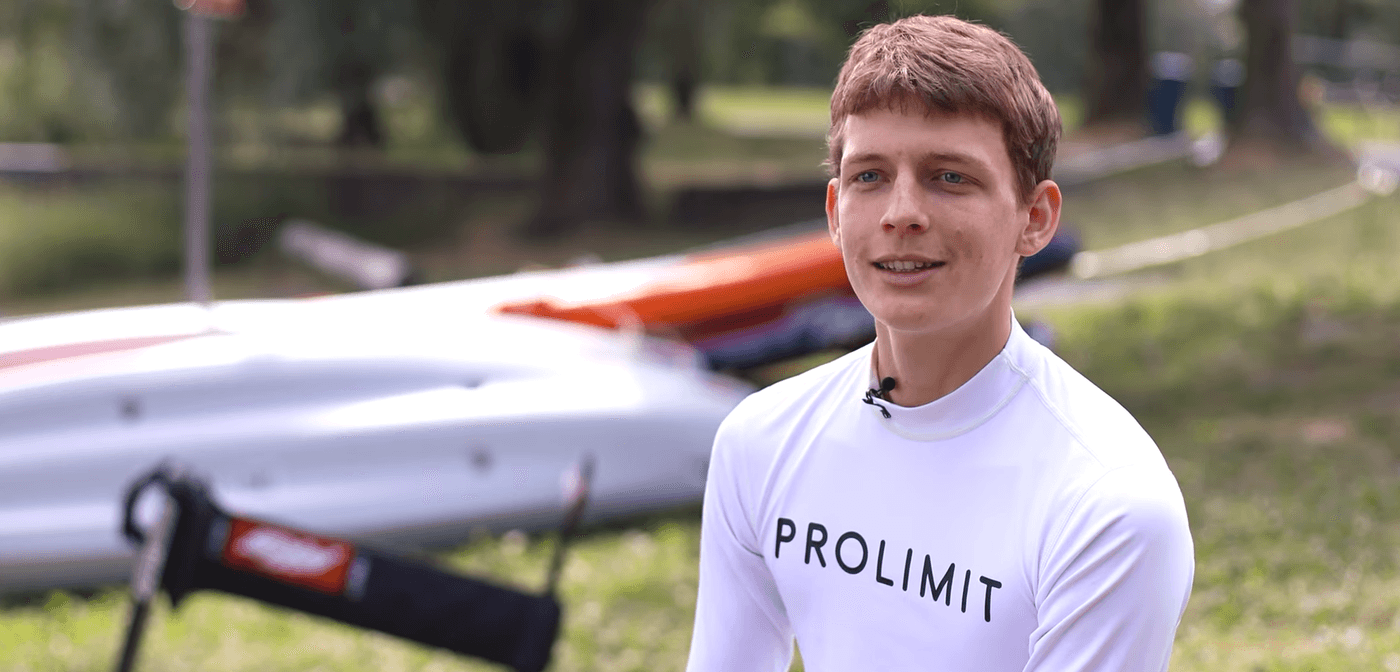
3D Printed Hydrofoil Molds with Jurij Scheibler
He builds his own hydrofoils, prints the molds and rides Lake Constance almost every day. In this Introducing 3D Maker interview, hydrofoil athlete Jurij Scheibler explains how 3D printing took him from a wooden-core kit to his own designs, and why TPU is one of his favorite materials.
From a wooden-core kit to riding almost every day
Tell us about yourself and how you got into hydrofoiling.
My name is Jurij Scheibler, and I've been hydrofoiling for about six years. I first saw it on the internet in 2018 or 2019, and then I built my first foil myself from a kit, where you get a milled wooden core and laminate it with fiberglass. Building has never let go of me since, and I ride almost every day.
How did competitions come into the picture?
More or less by chance. I ended up at a competition and rode along, and it went really well. Then I tried the World Tour as a test and did quite well there too. I decided to go more often, and not only for the competition but for the contacts, since all the exhibitors and many big names of the scene are there. That has opened up a lot of good opportunities.
What fascinates you about hydrofoiling?
You can do things that you couldn't have imagined a year ago, or ten years ago. Above all, you can use very little energy: waves that are barely visible, or so little wind that even sailboats just stand around. For a light-wind spot like Lake Constance, that means I can be out on the water almost every day. The number of water days multiplies with this equipment, and that's what makes it so interesting to me.
From printed foils to printed molds
How did 3D printing enter the picture?
About five years ago, after we had built that wooden prototype, we started designing our own foils. We printed them as a positive, so we printed the actual wing and then laminated carbon fiber onto the 3D printed wing. That worked surprisingly well, and we could ride the things. At some point the screws between the fuselage and the mast broke, and the whole part sank. Two years later, when it all got a bit more serious, I started with mold making and began 3D printing the negative molds. That worked right away.
What did printing the molds change?
It allows a much stiffer construction. You no longer laminate onto a core but into a shell, so you can produce a much denser layer, and you can also build without a core.
What else do you use 3D printing for?
Rapid prototyping for accessories, for example a harness for your sail, or very quick small prototypes for boards. And still for mold making, for multi-part molds that can't be fully milled or would be very complex. The great thing about 3D printing is that it's so versatile and usable for pretty much everything.
Did designing and printing come together?
Yes. Designing came out of the need to make my own designs, and today the easiest way to actually produce those designs is 3D printing, so the two went hand in hand. Luckily, 3D printing is super easy today and anyone can do it. It has become much easier even in the years since I started.
Choosing materials and print orientation
How do you choose a material for a part?
First I think about the environment the part will end up in, for example whether it will be in the water or not, and what temperatures it will be exposed to. The material depends on that.
What is the most important question when you print a part?
Usually it's the print bed orientation, so how you actually align the part on the build plate, and what other options there are to reinforce parts through orientation or design features. For us, the stiffness of a component plays a much bigger role than its weight, at least in the foil design itself. Other areas like board building are different, because there weight matters a lot. In the end it always depends on what you want to make.
Working with Extrudr
How did you find Extrudr?
The first printer I printed on belonged to a friend, and he printed with Extrudr material. Then I looked at the website and saw that they're more or less neighbors of mine, so I wrote them an email.
Which materials stand out for you?
TPU is one of the most fascinating materials for me, mainly because many videos present it as extremely hard to print. But it's really plug and play, just as simple as all the other materials as far as I know, and it's incredibly versatile. A lot of printed parts are made from TPU in different hardness levels, because flexible parts are so valuable and you can do fascinating things with them.
Flexible parts, printed with ease
Jurij calls TPU one of the most fascinating materials he prints with. Explore the Extrudr TPU range in different hardness levels.
Is there anything you haven't tested yet?
Fiber-reinforced plastics. I'm still a bit skeptical there. I know they convince visually, but whether they also convince structurally is the question.
Why does working with a manufacturer close to home matter to you?
A lot of products get outsourced to Asia, and in the whole foil industry almost everyone produces there now. That's not bad per se, since there's a lot of know-how there. But it's even nicer to work with a company that really develops and produces right here, because the distances are shorter, you can meet up spontaneously and shoot videos, and communication works much better. And when the products convince as well, it's great.
Hinweis: For the best print result with Extrudr filament, download our material profiles on extrudr.com.
Advice for anyone who wants to build a foil
What would you tell people who want to start building their own foils?
Funnily enough, more and more people are starting to build foils, and the only thing I can say is: don't be afraid of it. It's super easy, and even with very little planning you can produce a very usable product. 3D printing makes that possible because you don't have to deal with CAM software, you use much cheaper hardware than for milling, and the whole budget you need is much smaller than with other mold making methods. 3D printing is a total enabler in this field.
Lake Constance and the future of foiling
What makes Lake Constance special for you?
As banal as it sounds, I've probably spent most of my time on the water here, because I went to school here. It doesn't have a lot of energy, but when it does, it's proper. It's a unique spot. It's perfect for pump foiling, but pump foiling is only the tip of the iceberg. There are many other, more interesting disciplines, and the goal is to show that they're doable on Lake Constance too, so you don't necessarily have to fly to the sea to ride waves. The goal is to develop and produce equipment that's made for the conditions on Lake Constance.
How has the equipment changed?
It has developed so much over the last two years that every year there's a moment where you think, what I'm doing right now was completely unimaginable last year. That's really nice to see.
Where do you see the sport heading?
My hope is that lots of people start, and that soon you're no longer alone on the lake. For two or three years it has been growing considerably, not only here but also in Zurich, where I work at the moment. It's impressive how many people find it interesting, start and stick with it. I can imagine this sport getting quite big and staying relevant in the future.
Faster prototypes, and a printer that is a tool
What is next for you?
The foil itself. I recently started working as a self-employed developer for various companies, and software plays a big role, with a lot happening right now thanks to AI and the acceleration it brings. These are exciting times, and I think the iteration speed of prototype building will multiply. The goal is to speed up rapid prototyping, and 3D printing fits perfectly, because it was built for exactly that.
How has 3D printing itself changed?
It has become so simple to use that the printer is no longer a project but a real tool. You send off a job and it gets printed in the background while you do other things. That has existed for about two years. Even five years ago I found the technology interesting in itself, but by now consumer products are so good and easy to use that you can really use them as a tool. I expect it to keep getting better, with complex and high-end materials becoming easier and easier to process, and I don't see a limit yet.
Watch the exclusive interview
In this Maker Interview, hydrofoil athlete Jurij Scheibler shares how he got from a wooden-core kit to 3D printed molds, how he chooses materials and why Lake Constance is the place he wants to show what foiling can do.
Follow the Series
More makers, more workflows, more of what people are building with Extrudr filament. Next up in Introducing 3D Maker.
Read more maker stories