
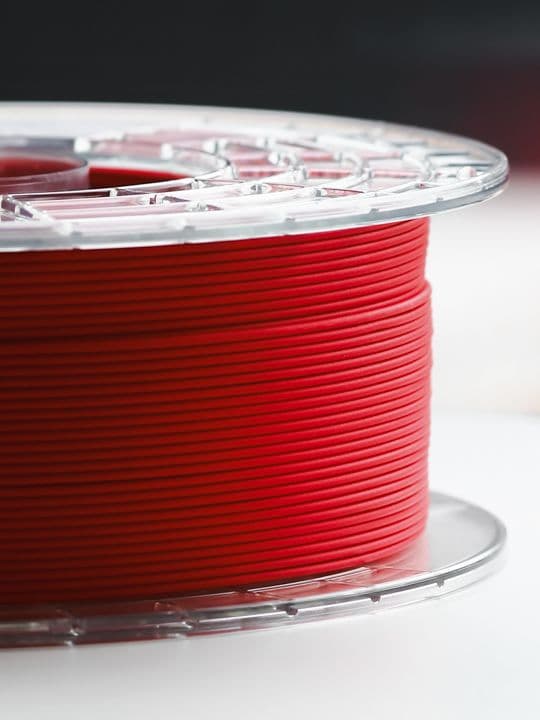
Spool Sizes Explained: Which One Fits Your Workflow?
The right spool size optimizes production, improves consistency, and lowers total costs. Here's how to choose.
Spool size shapes your production
Most users focus on material choice, and rightly so. But spool size is the overlooked variable that quietly determines whether your production runs smoothly or gets interrupted at the worst possible moment. Whether you're running 2.5 kg, 5 kg, or 10 kg rolls, the right match between spool size and application is the difference between a workflow that flows and one that frustrates.
Production, quality, logistics
1) Efficiency in Production: Larger spools = fewer interruptions
Every spool change costs you time. Pausing a print job, reloading filament, and re-priming the nozzle adds up, especially across a multi-shift operation or a farm of machines running in parallel. With 5, 8, or 10 kg rolls, long or continuous prints run without interruption. That means higher uptime, lower labor cost per part, and less risk of a mid-print failure from an unexpected runout.
2) Consistent Quality: One batch, one result
When you switch spools mid-series, you introduce the risk of batch variation. Even within the same material and color, subtle differences between production batches can show up in surface finish, dimensional accuracy, or mechanical behavior. Larger spools reduce the number of switches per production run, keeping your parts consistent from first to last. This matters most in functional parts, color-matched assemblies, and any application where repeatability is non-negotiable.
3) Smarter Logistics: Match the spool to your workflow
Spool size also shapes your storage and handling. Smaller spools simplify material testing and management for labs and design teams, with less waste when trialing a new material and easier access to multiple options. Larger spools streamline storage and reduce packaging waste for production setups, cutting down on the number of shipments, packaging units, and shelf space required to keep operations running.
Best for
2.5 kg
R&D, design teams, material testing, and low-volume prototyping where variety matters more than volume.
5 kg
Production batches and small print farms that need longer uninterrupted runs without full industrial overhead.
10 kg
Multi-shift operations, large print farms, and high-volume manufacturing where uptime is the priority.
| Size | Key advantage | Typical use cases |
| 0.75-2.5 kg | Easy to manage multiple materials and colors simultaneously | Design studios, labs, educational settings, early prototyping |
| 5 kg | Fewer changeovers, consistent batch quality across a series | Small batch production, functional prototypes, in-house manufacturing |
| 7-8 kg | Maximizes uptime; reduces logistics overhead | Print farms, multi-shift operations, parts manufactured at scale |
| 10 kg | Maximum continuity; lowest cost-per-kg; minimal packaging waste | Industrial production lines, OEM applications, continuous overnight runs |